 Call :
  Email :



COD Remittance
COD Remittance vs COD Settlement: What's the Difference?
Cash on Delivery (COD) continues to be one of the most preferred payment methods for online shoppers in India. While customers enjoy the convenience of paying after receiving their orders, businesses need a reliable system to receive those payments quickly and accurately. This is where terms like COD remittance and COD settlement become important.
Although these terms are often used interchangeably, they are not exactly the same. Understanding the difference helps e-commerce sellers manage cash flow, track payments, and choose the right logistics partner.
Understanding COD Remittance
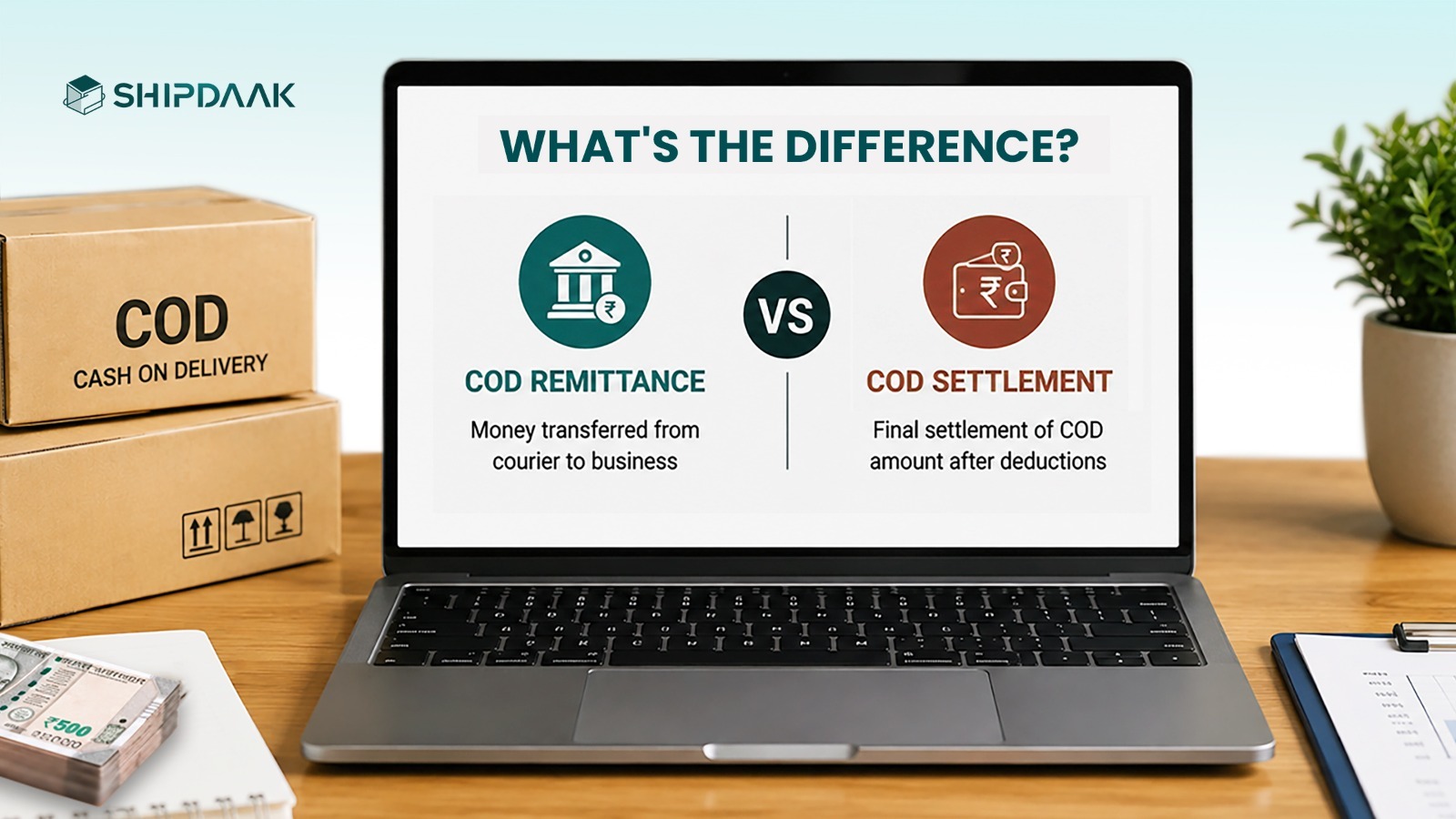
COD remittance is the process of transferring the cash collected from customers to the seller's bank account.
Here's how it works:
- The customer places a Cash on Delivery order.
- The courier partner delivers the package.real-time shipment tracking
- The delivery agent collects the payment.
- The courier company transfers that amount to the seller after deducting applicable charges.
The transfer of funds from the courier partner to the seller is known as COD remittance.
For e-commerce businesses, faster remittance means better cash flow, allowing them to restock inventory, run marketing campaigns, and manage daily operations without unnecessary delays.
What is COD Settlement?
COD settlement refers to the complete financial reconciliation of COD transactions.
It includes much more than simply transferring money. During settlement, businesses receive detailed reports showing:
- Delivered COD orders
- Collected payment amounts
- Shipping charges
- COD handling fees
- Returns and RTO adjustments
- Taxes or deductions (if applicable)
- Final payable amount
In simple words, COD settlement is the financial accounting process that confirms every COD transaction has been correctly calculated and reconciled.
COD Remittance vs COD Settlement
Although both processes are connected, they serve different purposes.
| Feature | COD Remittance | COD Settlement |
| Meaning | Transfer of collected COD money | Complete reconciliation of COD transactions |
| Main Purpose | Send collected funds to seller | Verify and calculate final payable amount |
| Focus | Payment transfer | Financial reporting and reconciliation |
| Includes Reports | Usually No | Yes |
| Includes Adjustments | Limited | Yes |
| Helps With | Cash flow | Accounting and financial accuracy |
Simply put:
- Remittance = Money Transfer
- Settlement = Money Verification + Financial Reconciliation
Why Both Matter for Online Businesses
Many sellers only focus on receiving payments quickly. However, receiving money without proper reconciliation can create confusion in accounting.
Both remittance and settlement are equally important because they help businesses:
- Maintain healthy cash flow
- Track every COD payment
- Identify payment discrepancies
- Manage returns effectively
- Improve financial planning
- Reduce manual reconciliation work
When both processes are handled efficiently, sellers spend less time checking reports and more time growing their business.
Common Challenges with COD Payments
Managing COD payments manually can become difficult as order volume increases.
Some common challenges include:
- Delayed Payments: Long remittance cycles can impact working capital and slow business growth.
- Missing Transaction Details: Without proper settlement reports, matching payments with delivered orders becomes time-consuming.
- RTO and Returned Orders: Cash collected only applies to successfully delivered orders. Returned shipments require proper adjustment during settlement.
- Multiple Courier Partners: Using several courier companies separately often means downloading reports from different dashboards, increasing manual work.
How a Logistics Aggregator Makes COD Management Easier
Instead of coordinating with multiple courier partners individually, businesses can manage everything from one platform.
A logistics aggregator like Shipdaak simplifies the entire COD process by offering:
- Multiple courier partner integration
- Faster COD remittance cycles
- Centralized shipment tracking
- Easy payment reconciliation
- Detailed settlement reports
- Transparent transaction history
- Better visibility into order performance
This reduces administrative work while improving payment accuracy.
Why Faster COD Remittance Matters
For growing online businesses, every day of delayed payment affects operations.
Faster remittance helps businesses:
- Purchase inventory sooner
- Pay vendors on time
- Improve cash flow
- Invest in marketing
- Handle seasonal demand efficiently
The shorter the payment cycle, the healthier the business finances remain.
Best Practices for Managing COD Payments
To avoid payment-related issues, businesses should follow a few simple practices.
- Monitor Settlement Reports Regularly: Review payment reports to ensure every delivered order has been accounted for correctly.
- Choose Reliable Courier Partners: Work with logistics providers known for timely remittance and transparent reporting.
- Track RTO Orders: Returned shipments should be monitored separately to avoid confusion in payment records.
- Automate Reconciliation: Using a logistics platform reduces manual calculations and minimizes errors.
- Keep Financial Records Updated: Maintain organized records of remittances, settlements, invoices, and deductions for easier accounting.
How Shipdaak Supports E-commerce Businesses
Managing COD payments becomes much easier when shipping and financial reporting work together.
Shipdaak helps businesses by providing:
- Fast and reliable courier aggregation
- Secure Cash on Delivery services
- Transparent COD remittance process
- Detailed settlement reports
- Real-time shipment tracking
- Multiple courier options
- Simplified shipping dashboard
By combining logistics management with efficient COD payment handling, Shipdaak enables online sellers to focus on customer satisfaction instead of payment tracking.
Conclusion
Although they are closely connected, COD remittance and COD settlement are two different parts of the Cash on Delivery process. Remittance refers to transferring the collected payment to the seller, while settlement ensures every transaction is accurately reconciled with detailed financial records.
Understanding this difference helps businesses manage their cash flow more effectively, maintain accurate accounts, and make informed financial decisions. Choosing a reliable logistics aggregator like Shipdaak further simplifies the entire process by offering transparent reporting, faster payment cycles, and seamless shipping management, making COD operations more efficient for businesses of every size.


